By using our website, you agree to the use of cookies as described in our Cookie Policy
Filing for Divorce in Harris County: What to Expect
Residency and Where You Can File
Texas Family Code Section 6.301 sets two residency rules. To file for divorce in Texas, one spouse must have been a Texas domiciliary for at least the preceding six months. To file in a specific county, that spouse must have lived in the county for at least the preceding 90 days. Both clocks have to be running at the time the original petition is filed.
Domicile means more than just sleeping somewhere. Courts look at voter registration, driver's license address, vehicle registration, employment records, and where the person actually intends to live indefinitely. If you moved to Houston four months ago from another state, you cannot file yet, regardless of how settled things feel. If you moved from Dallas to Houston four months ago, you meet the state test but not the county test.
Most divorces in our area are filed at the Harris County Family Law Center at 201 Caroline Street downtown. The building houses the family district courts and the associate judges who handle many of the routine hearings. Cases involving residents of family law matters in Fort Bend County are filed in Richmond, and the procedural rhythms there differ slightly from the Harris County system.
The Original Petition and What It Says
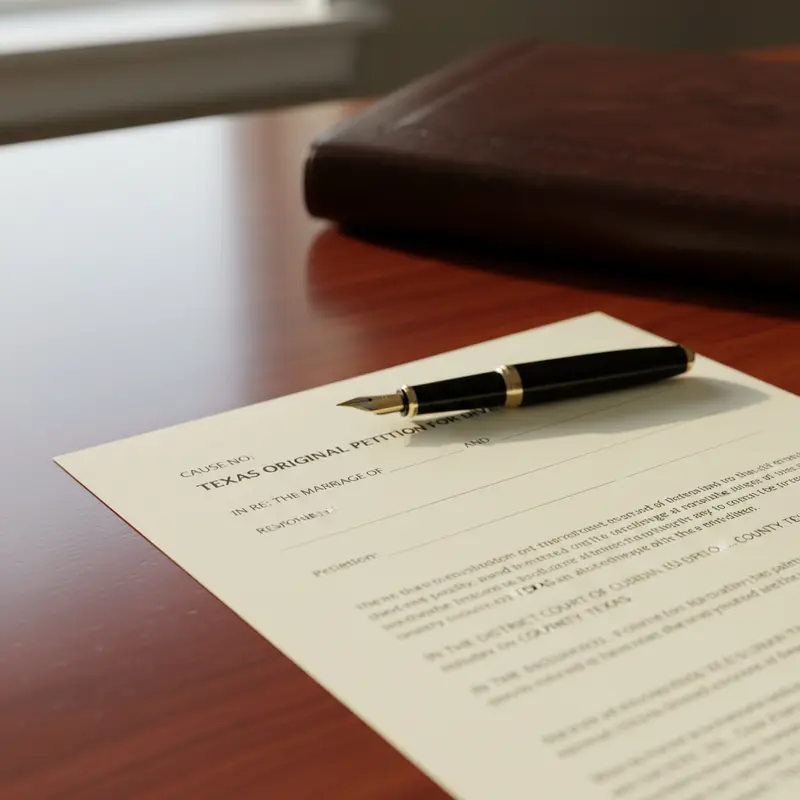
A Texas divorce starts when one spouse files an Original Petition for Divorce. The pleading identifies the parties, confirms residency, lists the marriage date and separation date, and asks the court for relief. Most petitions cite "insupportability" as the ground, which is Texas's no-fault language under Family Code Section 6.001. Fault grounds like adultery, cruelty, abandonment, and felony conviction still exist under Sections 6.002 through 6.007 and can affect property division.
The petition also sets the framework for everything to come: division of community property, debt allocation, conservatorship of children, possession schedules, child support, and spousal maintenance if it applies. Petitions filed without enough specificity create problems later, especially around retirement accounts, businesses, and real estate. We draft divorce petitions in Houston with the final decree in mind, not just the opening filing.
After filing, the petitioner pays the filing fee, currently around $350 in Harris County, and arranges service on the other spouse. Service can happen through a private process server, the Harris County Sheriff or Constable's office, or through a waiver of service signed by the respondent in front of a notary. The waiver route is faster and cheaper when both spouses are cooperative.
The 60-Day Waiting Period
Family Code Section 6.702 imposes a 60-day waiting period between filing the original petition and the earliest date the court can sign a final decree. The clock starts the day the petition is filed, not the day the other spouse is served. The legislature added this cooling-off period to discourage impulse filings and create space for reconciliation, even though most cases that reach filing do not reverse course.
Two narrow exceptions exist. The waiting period does not apply when the respondent has been finally convicted of, or received deferred adjudication for, family violence against the petitioner or a household member. It also does not apply when the petitioner has an active protective order against the respondent based on family violence. Outside those two categories, even fully agreed cases sit for the full 60 days.
In practice, most Harris County divorces take longer than 60 days. Even uncontested cases need time for inventory exchange, drafting the decree, and getting on the court's docket. A truly simple agreed divorce with no children and minimal property often finalizes in 75 to 90 days. Contested cases routinely run six months to two years, depending on the issues and the court's schedule.
Temporary Orders and the First Few Months
Before the divorce is final, the court can enter temporary orders that govern the parties' conduct during the case. Family Code Sections 6.501 through 6.507 cover the standard categories. These include temporary use of the residence, temporary spousal support, and temporary child support. They also cover possession schedules, restraining orders against asset dissipation, and orders preventing harassment or threats between the parties.
Temporary orders hearings usually happen within 30 to 45 days of filing. The hearing is short, often under an hour, and the associate judge is making fast decisions on limited evidence. Coming in unprepared is expensive because the temporary orders set the tone for the rest of the case. A bad possession schedule entered in week six is hard to undo at trial in month fourteen.
Cases involving children are particularly sensitive at this stage. The court is establishing what looks like a status quo, and Texas's standard possession order under Section 153.252 is the default the court starts from when the parents cannot agree. Custom schedules driven by work patterns, school logistics, or special needs require specific evidence and clear pleadings. We handle child custody arrangements in Texas with that long-term framing in mind.
Contested vs Uncontested Cases
An uncontested divorce is one where both spouses agree on every issue: property division, debt allocation, conservatorship, possession, support, and any name change. Uncontested does not mean simple. It means resolved. The agreement still has to be reduced to a written decree that complies with Texas law, and the court still has to approve it after the 60-day window. Uncontested cases often finalize for under $2,500 in attorney's fees per side.
A contested divorce is anything else. Disagreements over the family home, retirement accounts, a closely held business, or the children's primary residence push a case into the contested track. Contested cases involve mediation, depositions, expert witnesses on valuation or psychological issues, and sometimes a full bench or jury trial. Costs scale accordingly, often $15,000 to $50,000 per side and occasionally far more.
Most Harris County family courts require mediation before a contested final trial. A neutral mediator works with both sides for a half day or full day, and a high percentage of cases settle there. Texas mediated settlement agreements under Family Code Section 6.602 are binding once signed and acknowledged. This is one of the few situations in Texas civil practice where the agreement cannot be revoked by a party who later changes their mind. We handle the full range of Texas family law representation, from agreed pro se assistance to multi-day contested trials.
Community Property and the Final Decree
Texas is one of nine community property states. Family Code Section 3.002 defines community property as everything acquired during the marriage other than gifts, inheritances, and personal injury recoveries (excluding lost earnings). Section 3.001 defines separate property. The court divides community property in a manner it deems "just and right" under Section 7.001, which is not necessarily equal. Fault, future earning capacity, fault in the breakup of the marriage, and other factors can shift the split.
Identifying the character of each asset is often the most contested part of a divorce involving real money. A house bought before marriage is separate, but mortgage payments made with community income create a community claim against it. A 401(k) started before marriage has a separate component for the pre-marriage balance and a community component for everything contributed afterward. These tracing exercises require records, sometimes going back decades.
Once division is settled, the final decree memorializes everything: real estate transfers, retirement account divisions through Qualified Domestic Relations Orders, child support calculations under Family Code Chapter 154, possession schedules, and any name change. Child support in Texas follows statutory guidelines tied to the obligor's net resources, and the decree must include specific findings if the court deviates. We serve clients across Harris County family law representation and counsel them through every step from filing to final signature, with a initial consultation available through our Houston firm.
Frequently Asked Questions
How much does a divorce cost in Harris County?
The court filing fee is currently around $350, plus service costs of $75 to $150 depending on the method. Attorney's fees vary widely. An uncontested divorce with no children often runs $1,500 to $3,000 per side. A contested divorce with children, real estate, and retirement accounts typically runs $10,000 to $40,000 per side. High-asset or high-conflict cases can run substantially more.
Do I have to be separated before I can file?
No. Texas does not require a period of separation before filing. You can file while still living in the same house, although that is rarely a comfortable arrangement once temporary orders are in place. Some couples remain in the same residence during the 60-day waiting period for financial reasons, and the court can enter temporary orders dividing the use of rooms and assigning expenses.
Can I get spousal maintenance in Texas?
Texas spousal maintenance under Family Code Chapter 8 is narrower than alimony in many other states. Eligibility generally requires a marriage of at least ten years plus an inability to earn enough to meet minimum reasonable needs, or a finding of family violence within the two years before filing. The amount is capped at the lesser of $5,000 per month or 20 percent of the obligor's average monthly gross income, and the duration is capped based on the length of the marriage.
How is child custody decided in Texas?
Texas uses the term "conservatorship" rather than custody. The court starts from a presumption under Family Code Section 153.131 that joint managing conservatorship serves the child's best interest. One parent is typically designated as the conservator with the right to determine the child's primary residence, and a possession schedule sets out when each parent has the child. The standard possession order under Section 153.252 is the default, but custom schedules are common.
Can my spouse refuse to sign the divorce papers?
A spouse cannot block a divorce by refusing to sign. If the respondent refuses to sign a waiver of service, the petitioner serves them through a process server or constable. If the respondent then refuses to file an answer, the petitioner can take a default judgment after the 60-day waiting period. The case proceeds either way; uncooperative behavior just changes the procedural path, not the outcome.
‹ Back
Recent Posts
-

What to Do After a Car Accident in Houston, TX
May 5, 2026
-

Misdemeanor vs Felony Charges in Texas Explained
April 25, 2026
-
Filing for Divorce in Harris County: What to Expect
April 15, 2026