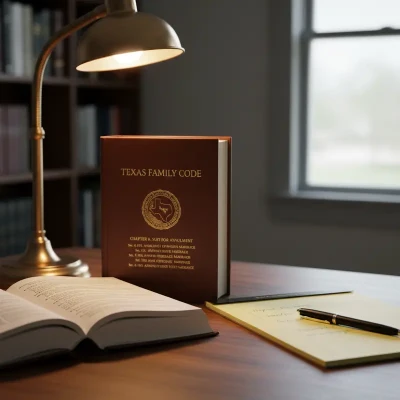
TEXAS ANNULMENT GROUNDS

Annulment Attorney in Houston

Voiding a marriage when statutory grounds apply under Texas law.

Annulment

What Annulment Representation Looks Like in Houston

An annulment is not the same as a divorce. Divorce ends a valid marriage. Annulment treats the marriage as if it never legally existed, and the grounds for annulment in Texas are narrow and statutory. Most clients who think they want an annulment actually need a divorce, and figuring that out at the consultation saves time and filing fees.

Annulment representation at this firm starts with the threshold question of whether the facts support one of the Texas Family Code grounds. These matters fit inside our broader family law work in Harris County, and when the facts don't support annulment, clients often shift to a standard Texas divorce filing instead.

Contact Us

Steps to a Texas Annulment

1

Annulment Consultation

We meet with you, talk through what happened, and assess whether the facts fit one of the Texas Family Code grounds for annulment.

2

Petition Drafting and Filing

If annulment is the right path, we prepare and file a petition pleading the specific statutory ground supported by your evidence.

3

Discovery and Evidence Building

Annulment cases need stronger evidence than no-fault divorces. We gather corroborating documentation and witness statements to support the pleaded ground.

4

Trial or Settlement

Contested annulments go to a trial where the petitioner proves the elements. Uncontested annulments can resolve at a brief hearing once the procedural waiting period passes.

Texas Family Code Chapter 6 lays out the grounds for annulment. They include marriage by a person under 18 without proper consent and intoxication that prevented understanding of the marriage. They also include concealed impotence, fraud, duress or force, mental incapacity at the time of marriage, and bigamy (which makes the second marriage void from the outset rather than merely voidable). Each ground has its own factual elements that have to be proven.

Fraud and duress annulments require evidence the marriage was induced by fraudulent representations or threats. The fraud has to go to the essence of the marriage, not minor misrepresentations. Hiding a serious criminal record, an existing marriage, or a fundamental incapacity to fulfill marital obligations may qualify. Hiding ordinary personality flaws or financial habits typically doesn't.

Underage marriage in Texas requires parental consent for minors aged 16 to 17 and a court order for marriages under 16. A marriage entered without proper consent can be annulled on petition of the minor's parent or guardian. The window for filing is short. Bigamous marriages are void from the outset and don't require an annulment proceeding, though sometimes a declaratory judgment is sought for clarity.

The procedural arc of an annulment looks similar to a divorce but with different substantive law applied. The petition pleads the specific statutory ground. The other spouse can answer and contest. Discovery proceeds. Trial decides whether the elements are proven. Successful annulments produce orders declaring the marriage void from the outset and addressing any property and child issues.

TEXAS ANNULMENT GROUNDS

Representation built on courthouse-tested experience.

Property division after annulment is more complicated than divorce because the legal theory is that no marriage existed. Texas case law has developed equitable remedies (constructive trusts, restitution) for sorting out property held during what turned out to be an invalid marriage. The analysis is fact-specific and works best with thorough records.

Children born during a marriage that's later annulled are still considered legitimate children of both parents under Texas law. Custody, possession, and support orders proceed the same way they would in a divorce. The annulment doesn't change the parent-child relationship.

Clients with potential annulment cases across Houston and the surrounding Harris County family bench should call early. The deadlines for some annulment grounds are strict. Sorting whether annulment or divorce fits your situation starts at (832) 703-0231.

TEXAS ANNULMENT GROUNDS

What Texas Annulment Law Actually Requires

TEXAS ANNULMENT GROUNDS

Annulment is rarer than divorce in Houston for a reason: most marriages don't fit the statutory grounds. The Harris County family courts see maybe a dozen annulment filings for every several thousand divorces. When the grounds do fit, the case is faster and cleaner than a divorce because it pleads to specific factual elements rather than general insupportability.

The most common Houston annulment grounds we see are fraud (concealment of a prior marriage, criminal record, or major incapacity) and intoxication marriages where one party was so impaired they couldn't have understood the ceremony. Both grounds require corroborating evidence beyond just the petitioner's word.

When annulment isn't available, Texas divorce on insupportability grounds reaches almost the same end result, with the marriage formally ending and property and child issues resolved. The firm handles those cases, often more efficiently than a contested annulment ever would.

What Texas Annulment Law Actually Requires

Reasons to Consider an Annulment in Texas

  • You discovered after marriage that your spouse concealed a prior existing marriage
  • The marriage happened while one of you was so intoxicated you couldn't understand it
  • The marriage involved someone under 18 without proper parental or court consent
  • One spouse lacked mental capacity at the time of the ceremony
  • You're considering annulment because of religious reasons, not just legal ones
  • Your spouse hid a serious criminal record or fundamental incapacity
  • A spouse used force, threats, or duress to obtain consent to marriage
  • You discovered concealed permanent impotence existing at the time of marriage
  • The marriage is recent (within months) and you have not consummated or settled into it
  • You're not sure whether annulment or divorce is the right path

What This Firm Brings to a Houston Annulment

  • Honest assessment of whether annulment fits or whether divorce is better
  • Strategic evidence development to support the pleaded statutory ground
  • Realistic timeline expectations and clear written fee agreement
  • Compassionate handling of what is typically a difficult and personal case
  • Direct attorney attention from the first consultation through final order
  • Coordination of property and child issues alongside the annulment proceeding
  • Westchase office reachable from across Houston for confidential meetings

Frequently Asked Questions

What's the difference between annulment and divorce in Texas?

Divorce ends a valid marriage. Annulment treats the marriage as if it never legally existed. Annulment requires proving specific statutory grounds (fraud, duress, intoxication, underage, etc.) while divorce can be granted on no-fault insupportability grounds.

How fast can I get a Houston annulment?

Annulments don't require the same 60-day waiting period as divorces in some configurations, but they do require proving the statutory ground. Uncontested annulments can resolve in 30 to 60 days. Contested cases take longer.

Does Texas recognize religious annulments?

Religious annulments granted by a church are separate from civil annulments granted by a court. A religious annulment doesn't affect your civil marital status. If you need to be legally unmarried, you need either a civil annulment or a divorce.

Can I annul a long-term marriage in Texas?

Generally no. Texas annulment grounds typically require prompt action after the basis for annulment is discovered. A long-term marriage is much more likely to require Texas divorce rather than annulment.

What happens to children if my marriage is annulled?

Children born during the marriage remain the legitimate children of both parents under Texas law. Custody, possession, and support orders are entered alongside the annulment, similar to a divorce decree.

Schedule a Annulment Consultation

Tell us about your case. We will explain your options in plain English, with no pressure to hire us at the call.

Request a Schedule a ConsulationCall (832) 703-0231

Free Instant Case Review

Free Instant Case Review